


If you've been following my blog or my book, you'll know that I have an acronym to help with strategy-building: STRATEGY.
- S for Scenario
- T for Targets
- R for Reach
- A for Awareness
- T for Tactics
- E for Execution
- G for Generate
- Y for Yield
The first step, S, involves looking at your current Scenario. I've covered the basics of this before, but today I'd like to take you a little deeper.
A big part of the Scenario stage is situational analysis. A good situational analysis is the springboard that will launch your entire strategy to success. But what is a situational analysis, and how can you perform one well?
What is situational analysis?
A situational analysis starts with a question: where is the business now?
This seems like a really simple question, doesn't it? But there's actually a lot to consider if you're going to get a useful answer.
Situational analysis involves analysing the context of your organisation by assessing the internal (micro) and external (macro) factors which could be affecting it.
Micro factors have a direct impact on your marketing operations. Sometimes, you can control these influences, for example by assigning resources. Macro factors are less controllable: it's unlikely that you can alter the economy, so you have to manoeuvre your way through the pre-existing macro environment.
Micro factors can be assessed using the SWOT and SWOTELL models. For the macro environment, PESTLE is best. In this first part, I'll introduce SWOT and SWOTELL, and explain how they can help you analyse your micro factors.
What are micro factors?
Calling them micro factors is a bit unfair. It implies that they're somehow less important than macro factors, and that's not the case at all.
Micro factors are the factors which affect an organisation internally, and the resources which help it to respond to these factors. Examples include:
- Team skills
- Budget
- The structure of your organisation
- Brand reputation
- Supplier relationships
Analysing your micro factors will help you to understand what you're capable of, how you can use your skills and resources to your best advantage, and what needs to change for your campaign to run effectively.
If you launch a campaign without first understanding your micro factors, you'll quickly find yourself out of your depth. You might over-reach, or under-reach. You might make goals you can't realistically achieve, or promise resources you don't actually have.
SWOT
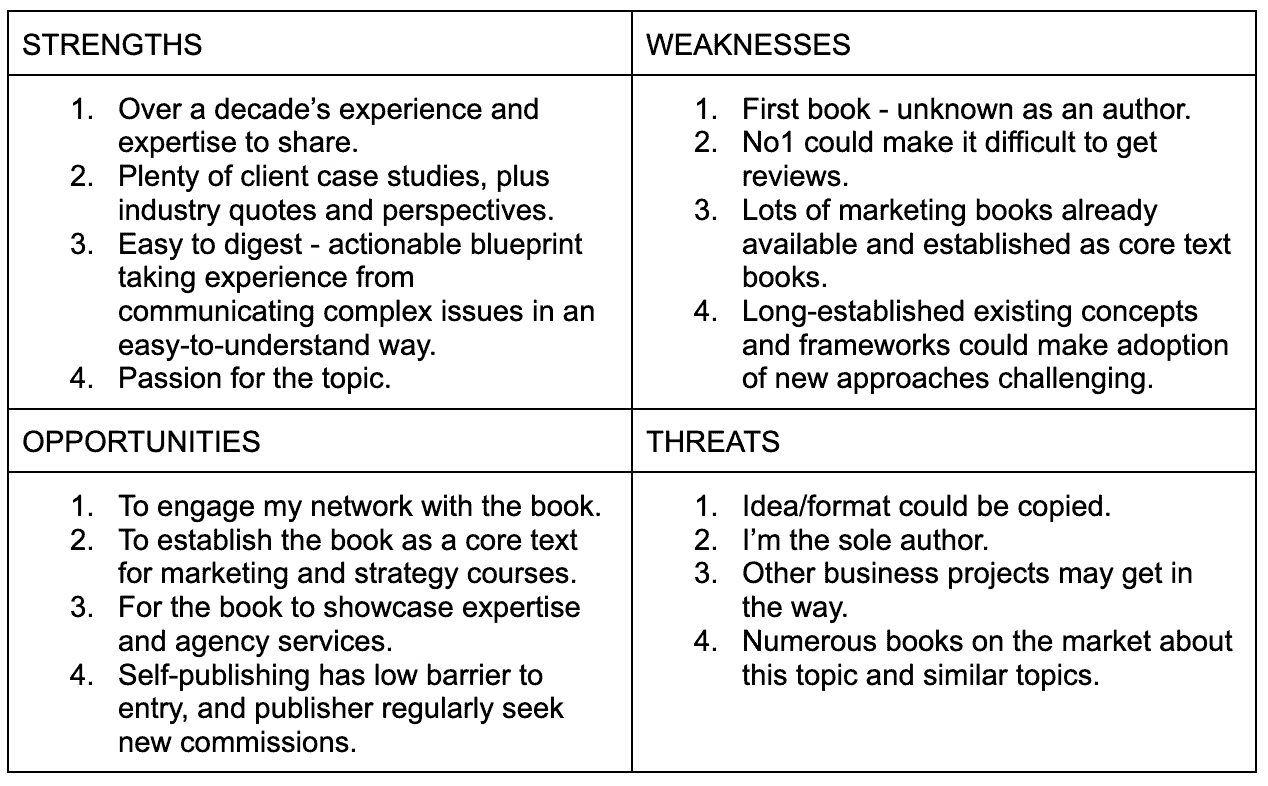
SWOT is the classic framework for getting situational awareness. It stands for Strengths, Weaknesses, Opportunities, Threats.
SWOT analysis is a simple but effective way to understand the micro factors which could affect your campaign.
You'll often notice some overlap in a SWOT. That's not uncommon. In fact, you may sometimes find that something you identified as a threat or weakness can also be an opportunity. For example, the fact that other marketing books are already established as core texts is a weakness, but it also presents the option for a new book to become a core text as an opportunity. The fact that there are several core marketing texts indicates that there's an interest in and a need for such books.
SWOTELL
SWOT is a fantastic framework, but it could be better. So the next time you're using a SWOT, consider adding ELL.
SWOTELL stands for Strengths, Weaknesses, Opportunities, Threats, Existing, Limitations, Leverage.
Those three extra letters are specifically marketing-focused. By using them, you'll really dig down into what you'll be working with as you start your campaign.
So, while SWOT tells you about the general micro factors affecting your business, ELL builds on that to give you a deeper, more nuanced understanding of how those, and other more specific factors, affect your marketing.
The macro factors are covered in the next post in this series.